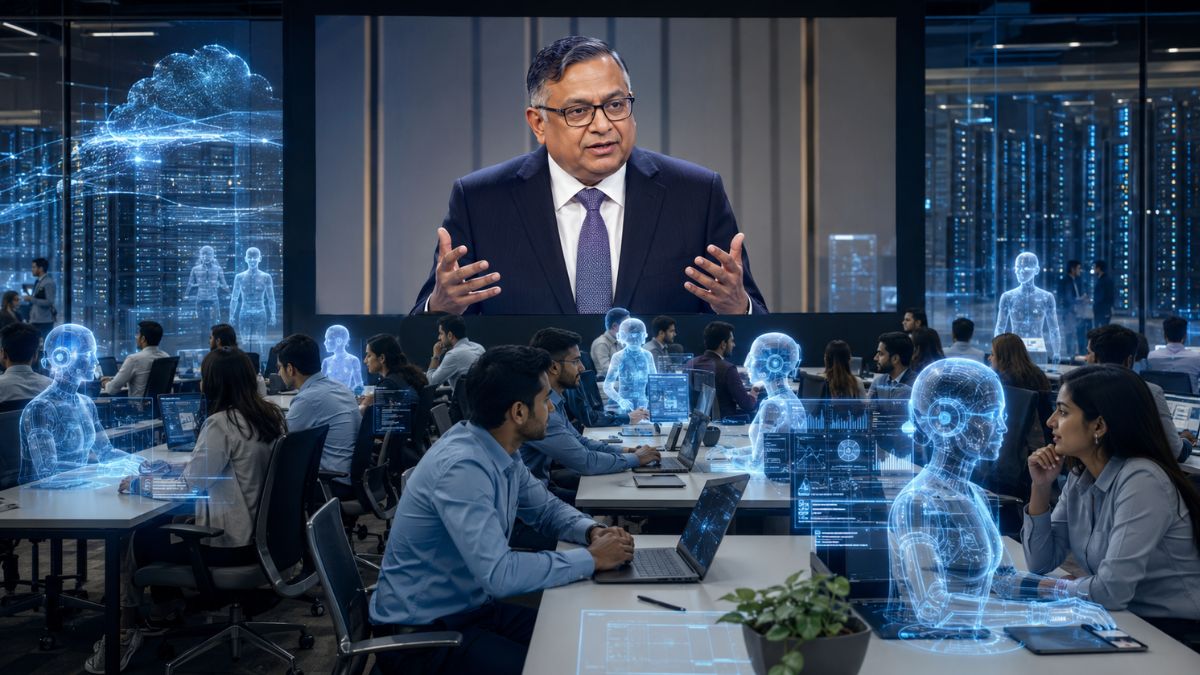
TCS Predicts AI Agents Will Match Workforce Within Three Years
TCS Chairman N Chandrasekaran forecasts a significant shift in workforce dynamics, predicting that AI agents will soon rival human employees, while emphasizing commitments to job creation and talent development.
AI Agents to Match Human Workforce
At the company’s annual general meeting, which was held virtually, Chandrasekaran stated, “I predict that over the next three years, TCS will have as many AI agents as human employees.” He noted a notable shift in hiring practices, saying, “Will it lead to decrease in hiring? Absolutely. The company will not be hiring the kind of numbers it used to hire.”
AI Ambitions Quantified
Chandrasekaran elaborated on TCS’s ambitious AI goals, indicating that if the company has around half a million employees, “the day is not far when the company has half a million AI agents.” He explained that many tasks currently performed by human employees will begin to be executed by AI systems, fundamentally altering the traditional workforce model.
Assurance Against Downsizing
Despite the integration of AI, Chandrasekaran reassured stakeholders that there would not be any workforce reductions. “There is no downsizing of staff. That is not planned at all,” he confirmed. He also highlighted the importance of reskilling efforts, aimed at creating a collaborative environment between human employees and AI agents.
AI’s Revenue Impact
Discussing the financial implications of AI, Chandrasekaran stated that TCS’s annualized AI revenue run-rate reached $2.4 billion in the fourth quarter of FY26, reflecting a compound quarterly growth rate of 22.4%. He predicted, “On an annualized basis, I expect the AI revenues to grow 100%.”
A Historic Opportunity
Chandrasekaran emphasized that AI represents the most significant opportunity TCS has encountered in its history, asserting, “By 2028 to 2030, 100% of the revenue will have an AI component.” This integration is expected to enhance TCS’s services and solutions.
Investment in AI Infrastructure
To facilitate this transition, TCS is committing resources to talent development, proprietary assets, and an innovative AI operating system that combines industry-specific AI agents with integration tools for new applications.
Expansion Beyond Traditional Models
Additionally, TCS is investing in AI data centers and sovereign cloud infrastructure, areas that extend beyond its historical asset-light operating strategy. Chandrasekaran stated, “This is not to say that the company’s philosophy is to go away from the asset-light model. The company will continue to pursue the asset-light model but will make the necessary exceptions.”
Strategic Acquisitions and Geopolitical Considerations
Addressing the topic of acquisitions, Chandrasekaran affirmed that TCS has the financial capacity to pursue significant deals, emphasizing, “There is absolutely no hesitation on the part of the board or the company to allocate funds for large acquisitions.” However, he noted that a disciplined evaluation of opportunities would remain a priority.
Global Trends Affecting TCS
Furthermore, he acknowledged geopolitical tensions that could disrupt global supply chains, causing enterprises to focus more on resilience. He reiterated TCS’s ambition to achieve double-digit growth and underscored that the US would remain the company’s largest market, while also addressing concerns regarding employment visas.
Long-Term Operational Goals
Chandrasekaran maintained that a sustainable operating margin of around 25% will continue to be achievable in the long run.